

The Homeowner’s Guide to Measuring for Wall-to-Wall Carpet
You’ve spent hours browsing our Killeen showroom, falling in love with the “Warm Minimalist” oaks or the cloud-like luxury of a new Triexta carpet.
But before the first roll is cut, there is one critical question that every homeowner asks: “How much is this actually going to take?” Measuring for wall-to-wall carpet is significantly more complex than measuring for a rug or even for LVP. Because carpet comes in fixed widths—usually 12, 13, or 15 feet—it’s not just about square footage; it’s about “linear” planning and seam placement.
At Technique Flooring & Restoration, we have spent over 35 years “Flooring Central Texas with Excellence.” While our IICRC-certified team always performs a precision measurement before you buy, this guide will help you estimate your needs so you can plan your 2026 home upgrade with confidence.
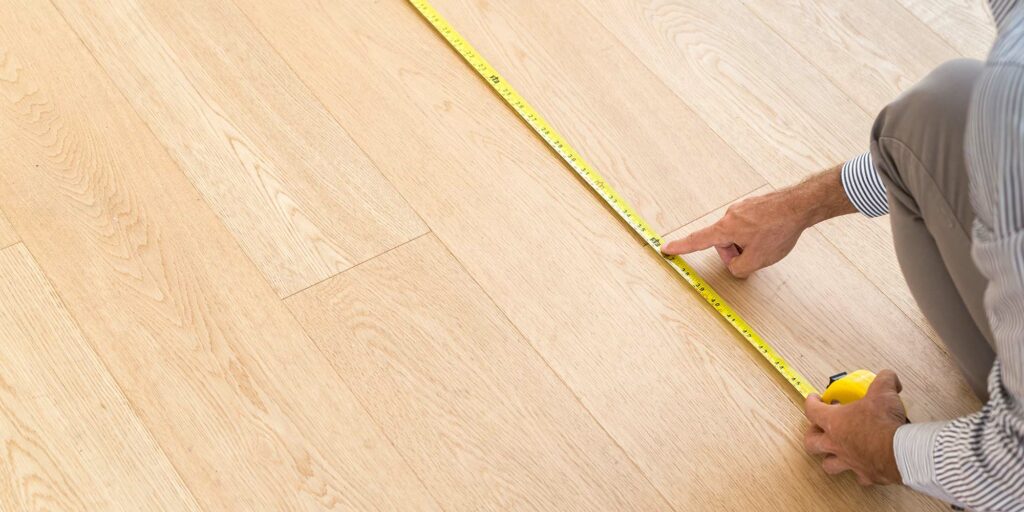
How to Measure Wall to Wall Carpeting
1. The Basic Math: Square Feet vs. Square Yards
In the flooring world, carpet is often discussed in square yards, but most homeowners measure their rooms in square feet.
- The Formula: To find your square yardage, multiply the length of the room by the width (in feet) to get the square footage. Then, divide that number by 9.
- The Example: A $12 \times 15$-foot room is 180 square feet. $180 / 9 = 20$ square yards.
- The Technique Tip: Always round up to the nearest foot before you multiply. If a wall is 11 feet 4 inches, treat it as 12 feet. In flooring, it’s always better to have a few extra inches for trimming than to be a few inches short!
2. The “Fixed Width” Factor
This is where DIY measurements often go wrong. Most carpets are manufactured in 12-foot widths. If your room is 13 feet wide, you cannot simply buy 13 feet of carpet; you have to buy a 12-foot wide roll and “seam” in an extra foot-wide strip.
- The Strategy: Professional measurers look for ways to minimize these seams. In 2026, with the trend toward “Lived-In” luxury and high-texture fibers, hiding seams is easier than it used to be, but placement is still key. We avoid putting seams in high-traffic “walking paths” or directly in front of a sun-drenched window where the light might catch the fibers.
3. Measuring the “Complexities”: Closets, Nooks, and Doorways
A room is rarely a perfect rectangle. In many Killeen and Temple homes, we deal with recessed windows, built-in bookshelves, and walk-in closets.
- Closets: Never forget to measure into the back of the closet. The carpet should be continuous from the bedroom into the closet for a “New Heritage” seamless look.
- Doorways: Measure to the center of the doorway (under the door). This ensures the carpet meets the transition strip or the adjoining flooring perfectly without a gap.
- Nooks: For L-shaped rooms, treat the space as two separate rectangles, calculate the area for both, and then add them together.
4. Accounting for “Waste” and Pattern Matches
In 2026, we are seeing a massive resurgence in Patterned Carpets—think Herringbone, Chevrons, or geometric “Loud Rug” styles.
- Pattern Match: If your carpet has a repeating pattern, we have to order extra material to ensure the patterns line up perfectly at the seams. This is called the “Pattern Match Waste.” Depending on the size of the repeat, this can add 10% to 20% to your total order.
- Standard Waste: Even for a solid carpet, we typically add a 10% waste factor to account for cuts, doorway trimming, and the “fluff” needed to tuck the carpet into the tack strips along the baseboards.
5. The “Vertical” Challenge: Measuring Stairs
Stairs are the most labor-intensive part of any carpet installation. You aren’t just measuring a flat surface; you are measuring the “tread” (where you step) and the “riser” (the vertical part).
- The Method: Measure the width of the stair, then measure the depth of one tread and the height of one riser. Add the tread and riser together, multiply by the number of stairs, and add a few inches for the “wrap” around the nose of the step.
- The Pro Touch: Because stairs take the most abuse, we often recommend using a high-resiliency Nylon or Triexta fiber here, as we discussed in Blog #1.
Shop for New Carpet Flooring in Killeen, TX from Technique Flooring & Restoration
A DIY estimate is a great way to start your budgeting process, but for the final cut, you want the precision that only comes with 35 years of experience. A measurement error of just a few inches can lead to an unsightly seam or an expensive re-order.
At Technique Flooring & Restoration, we take the guesswork out of the process. Our IICRC-certified experts use professional-grade tools to map out your home, ensuring the most efficient use of material and the cleanest possible installation.
Voted the Best of Central Texas for 10 years straight, we don’t just “sell carpet”—we provide a tailored flooring solution that fits your home’s unique footprint perfectly.
Carpet & Installation Frequently Asked Questions (FAQ)
Q: Should I pull up my old carpet before I measure?
A: It’s not necessary! We can measure right over your existing flooring. In fact, keeping the old carpet down can sometimes help us see where the original seams were placed.
Q: Do I need to buy new padding if my old padding looks okay?
A: Yes! We always recommend new padding. Padding is the “shock absorber” for your carpet. Old padding has likely lost its resilience and can harbor 2026 allergens and odors that you don’t want under your new floor.
Q: What is a “seam plan”?
A: A seam plan is a blueprint our installers use to decide where the carpet pieces will meet. We aim for “low-visibility” areas, away from direct light and heavy foot traffic.
Q: Can I use the “waste” scraps for anything?
A: Absolutely! We can often take larger scraps and have them “bound” into small mats for your garage entry or closets. It’s a great way to use every bit of your investment.